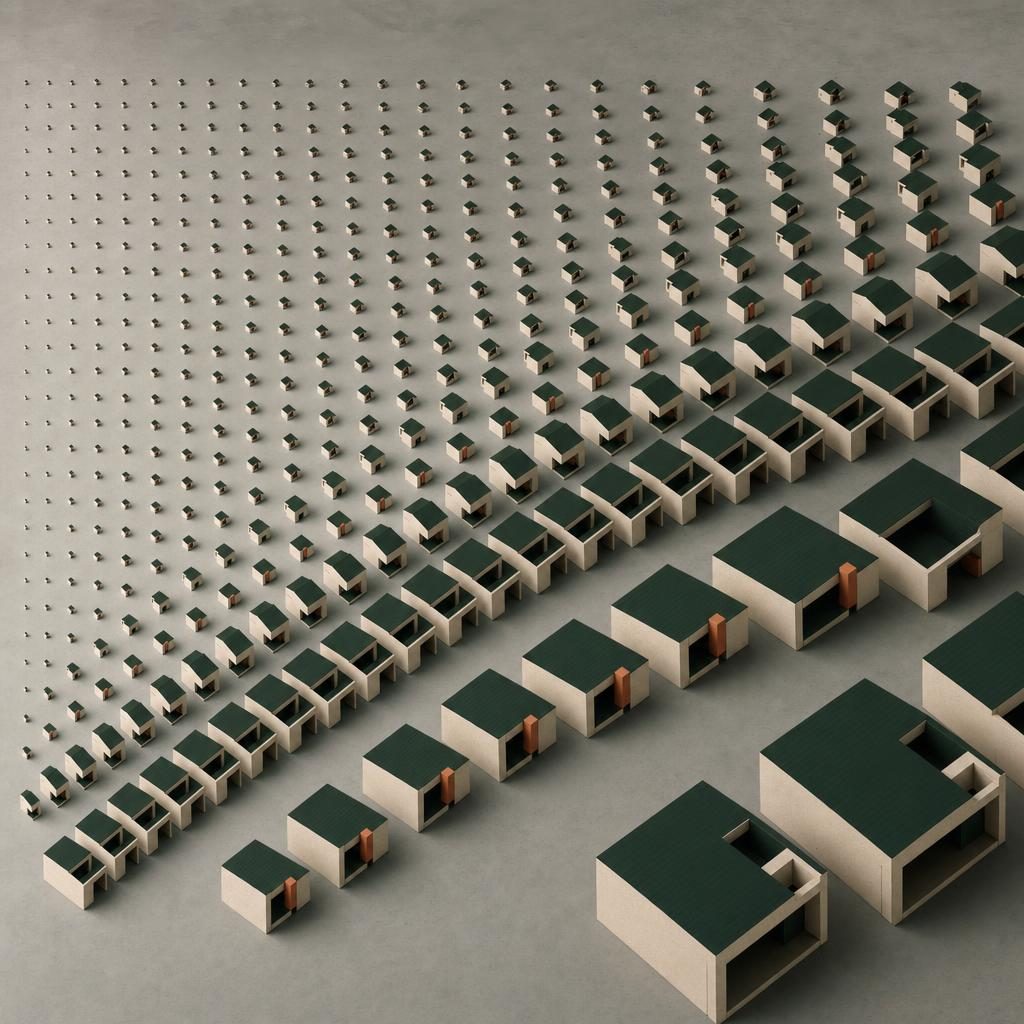
Homebuilding is Warfare, and Most Builders Don't Know
They’re in a Fight
I've always been fascinated by the relationship between warfare and business. The parallels aren't superficial - they run deep into how we think about strategy, competition, leadership and execution under uncertainty. In 2004, I wrote an article for Builder Magazine entitled "Lessons from The Art of War," applying Sun Tzu's principles to the homebuilding business. Recently, I came across my notes from that piece and decided the subject deserved a much deeper treatment. Sun Tzu was the starting point, but two other prominent figures in military strategy, Napoleon Bonaparte and Carl von Clausewitz, have also created powerful lessons for builders. What follows is that deeper discussion.
There’s a reason military metaphors so easily creep into business conversations. It isn't laziness. It's recognition. The builder who commits capital to a piece of dirt, bets on a product line, prices against competitors he can't fully see, and tries to execute through a workforce he doesn't fully control - that builder is a field commander. The stakes are real and the fog is thick, and the long list of builders who didn't survive is populated by people who thought they were in a construction business when they were actually in a war.
Three strategists across twenty-five centuries understood this better than anyone: Sun Tzu, the ancient Chinese general who wrote The Art of War somewhere around the 5th century BC; Napoleon Bonaparte, whose campaigns rewrote European warfare in the early 1800’s; and Carl von Clausewitz, the Prussian theorist whose treatise, On War, codified what Napoleon practiced. Their insights into warfare translate into homebuilding with an almost disturbing precision. Not as a metaphor, but rather as an operating doctrine.
I. Sun Tzu: Win Without Fighting
Sun Tzu's The Art of War is the oldest of the three works, yet it feels more modern than either of the others. The core philosophy would be radical even today: the supreme art of war is to subdue the enemy without fighting.
For builders, this is the art of positioning. It's winning the land deal before competitors know it's available. It's understanding absorption rates and buyer psychology so well that your pricing captures margin without generating resistance. It's having the right product in the right location at the right time, so that sales seem to happens almost effortlessly.
Sun Tzu's most quoted line is his most practical: "Know the enemy and know yourself; in a hundred battles you will never be in peril." This is intelligence superiority, and it applies with full force. The builder who enters a market without understanding the competitive landscape, or knowing what's selling at what price per square foot, or grasping the demographic profile of the buyer pool - that builder is fighting blind. And blind fighters lose.
Twenty-five centuries before absorption rates and comp data, Sun Tzu knew that the general who maps the terrain before marching doesn't need to fight for what he can simply take.
"Know yourself" is equally important. What are your actual cycle times? Not the ones on the schedule
- the real ones. What is your actual cost variance by trade? What does your warranty data actually say about where your construction process breaks down? The worst mistakes are the ones that happen more than once, and they keep happening because builders don't study their own operations with the same commitment they'd apply to a competitor.
Sun Tzu emphasized economy of force - never commit resources where they aren't decisive. This is value engineering in its truest sense, not cheapening the product, but right-sizing every element to deliver maximum perceived value at minimum real cost. It's understanding the difference between base product and augmented product, between what the buyer needs and what the buyer thinks they need, between the feature that sells and the feature that just adds cost.
And then there's Sun Tzu's most subtle insight: adaptability. "Be like water," he wrote. Water takes the shape of the terrain it encounters. It doesn't force - it flows. In homebuilding, this is the willingness to change course when circumstances change. To modify a product line that isn't selling instead of doubling down on a bad bet. To adjust pricing when the data demands it instead of clinging to the original proforma. The reality of the environment within which you are operating may not be perfectly analogous to the one you envisioned when you wrote the plan.
The perfect solution delivered too late is not perfect at all. Sun Tzu understood this 2,500 years before any of us poured a foundation.
II. Napoleon: Speed, Concentration and the Cost of Overreach
Napoleon was less a theorist than a practitioner of genius. He didn't write doctrines - he was the doctrine. His principles must be extracted from what he did, and what he did was win through three interrelated advantages: speed, concentration of force and superior logistics.
For builders, Napoleon's speed translates directly to cycle time - the single most underestimated driver of profitability in our industry. Producing more volume with the same overhead by reducing cycle time increases bottom-line profit dramatically. You're effectively reducing the indirect cost for every house by spreading fixed overhead over a larger number of homes. The builder who turns lots fastest dictates terms to the market, just as Napoleon dictated terms to coalitions of slower opponents.
Napoleon's principle of concentration of force is equally powerful. He never divided his army when he could mass it at the decisive point. Too many builders do the opposite - they chase three new communities when they can't properly staff two. They spread their superintendents thin, overload their trade base and fragment their attention across multiple fronts. The result is victory nowhere because they've committed everywhere.
Each builder must find the right compromise between ambition and capacity. A superintendent with 12 houses on one street just walks down the block. That same superintendent with 12 houses scattered across four communities spends half the day driving. The math of concentration isn't complicated - it’s the discipline to practice it that is.
Twelve houses on one street and a super just walks the block. Scatter those same twelve across four communities and you've divided your army, exactly what Napoleon warned against
This connects directly to Napoleon's genius for logistics. He understood that armies run on supply lines, not courage. In homebuilding, your supply line is your trade base. Becoming a preferred customer - reliable volume, clean and organized jobs, rigid adherence to payment terms, no whining - is the operational equivalent of Napoleon's logistical revolution. The builder who is first on the trade's schedule, who gets the A-crew instead of the B-crew, who has pricing stability while competitors are re-bidding every job, has a structural advantage that is hard to beat.
But Napoleon's story also contains the most important cautionary lesson: overreach. Moscow.
Waterloo. The pattern is identical. Early success breeds ambition. Ambition outruns the supply lines. The army advances beyond its ability to feed itself, and what looked like conquest becomes catastrophe.
We see this in every cycle. The builder who sells seven homes in a month when the operation can start three doesn't have a sales problem - he has a discipline problem. The slot start system exists for exactly this reason. Sometimes the discipline to NOT start everything immediately creates more value than the temptation to accelerate every sale. Buyers appreciate realistic timelines over missed deadlines. Banks appreciate predictable draws. Superintendents appreciate manageable workloads. Napoleon at Austerlitz was brilliant. Napoleon in Russia was the same man with the same talent, destroyed by his refusal to recognize that no army, however brilliant its commander, can outrun its own supply lines forever.
III. Clausewitz: The Nature of the Fight
Carl von Clausewitz, the Prussian general who gave us On War in 1832, is remembered primarily for one sentence: "War is the continuation of politics by other means." Translated to our business: building is the continuation of strategy by other means. The house you construct is not the strategy. It's the physical manifestation of dozens of upstream decisions: land, product, pricing, financing, hiring - that either converge into a winning position or don't. The builder who focuses only on the house has confused the tactic for the strategy.
But Clausewitz's most useful concept for builders isn't that famous line. It's his concept of friction.
Friction is the accumulated weight of everything that goes wrong between the plan and the execution. The inspection that fails. The lumber delivery that arrives on Wednesday instead of Monday, which pushes framing to the following week, which bumps the plumber, which cascades into a three-week delay on a house that was supposed to close in 90 days.
Every builder reading this just nodded. You live in friction.
The figure running ahead of the cascade is every superintendent who's ever tried to outpace a chain reaction of delays. Clausewitz would recognize the scene instantly, he just called it war.
What Clausewitz understood is that friction isn't a failure of planning - it's a condition of the operating environment. The gap between a perfect schedule and messy reality isn't something you eliminate. It's something you manage. That's why the 10 Rules for Cutting Cycle Time exist - not to create a frictionless process (impossible), but to build a system that absorbs friction and keeps moving. Control the customer. Control the product. Control the regulatory process. Never wait for yourself. These are much more than aspirational platitudes - they are, in fact, friction-reduction protocols.
Clausewitz also gave us the concept of the center of gravity - the single source of an enemy's strength that, if you break it, collapses the entire position. In a competitive market, you need to ask a hard question about every significant competitor: what is the one thing holding their position together? Is it their land position? Their trade relationships? Their pricing discipline? If you can identify it and neutralize it, the rest of the competitive problem simplifies dramatically.
And then there are moral forces. Clausewitz argued passionately that willpower, morale and the quality of leadership matter more than material superiority. The quote "An army of sheep led by a lion is better than an army of lions led by a sheep" has always been one of my favorites. In our business, this is the difference between companies with real culture and companies with a plaque on the wall. The builder whose team believes in the mission, who has earned loyalty through accessibility and example, will outperform the better-capitalized, better-located competitor whose people are just showing up. Conviction backed by preparation is worth more than all the capital in the world.
IV. The Builder-General: Synthesis
What's remarkable is how thoroughly, despite being separated by centuries, cultures and circumstances, these three strategists agree on the fundamentals.
Strategy beats tactics. All three insist that the upstream decisions - where to fight, when to fight, what to fight for - matter infinitely more than the moment-by-moment execution. For builders, this means the land decision, the product decision and the pricing decision ARE the war. Construction is just the execution of a strategy that was already a winner or a loser before you pulled a permit.
Sun Tzu's intelligence, Napoleon's speed, Clausewitz's resilience, the builder who commands all three doesn't just survive the fight. He shapes it.
Preparation beats reaction. Clausewitz's friction, Napoleon's logistics, Sun Tzu's intelligence - all three point to the same truth. The army (or company) that has done the homework, built the systems, and prepared for contingencies doesn't need to be lucky. The builder who shows up to a new market with absorption data, demographic analysis, competitive intelligence and a clear product strategy isn't gambling. He's executing a campaign.
The leader determines the outcome. Clausewitz's moral forces, Napoleon's personal command at the decisive point, Sun Tzu's emphasis on the general's wisdom - all three knew that organizations reflect their leaders. A building company with strong leadership, clear values and genuine culture will outperform a better-resourced competitor with weak leadership every time. It is not the competitors who justifiably change their minds that we must fear. The truly dangerous people are those among us unwilling or incapable of changing regardless of new circumstances.
Overreach kills. This is the lesson Napoleon learned at Moscow, that Clausewitz codified, and that Sun Tzu anticipated. In homebuilding, overreach is the mistake most builders don't recognize until the market turns, and by then it's too late. The temptation to start more homes, enter more markets, take on more complexity than the organization can absorb - this is how otherwise competent builders destroy themselves.
V. Final Thoughts
Every community you develop is a campaign. It has an objective, a budget, a timeline, a competitive environment and a team that must execute under conditions of uncertainty. The builder who treats it as "just another neighborhood" is the general who marches without reconnaissance.
Sun Tzu would tell you to win before the fight starts - through knowledge, positioning and the discipline to adapt.
Napoleon would tell you to move fast, stay concentrated, and never, ever outrun your supply lines.
Clausewitz would tell you to plan for friction - build systems that absorb it instead of pretending it won't happen.
Over twenty-five years ago, when I wrote The Road to Success, one of its core principles was the Law of Action: don't wait for things to happen, make them happen. That was true then, and it is even more true today. Action alone makes things happen. Without it, we cannot impact our future or shape our own destiny.
Position like Sun Tzu
Plan like Clausewitz
Move like Napoleon
But above all - ACT. The builders still standing when the economy turns will be the ones who understood that this was never just a construction business. It was always a war.
Written by Al Trellis in collaboration with Atlas by Real Torch. To put Atlas to work for your team, please contact Michael Burdette at michael@realtorch.ai