Most people think of attitude as a single dial. Positive or negative, glass half full or half empty. Motivational speakers tell you to stay positive. Cynics tell you the world doesn't care how you feel. Both are right. Both are incomplete.
Your attitude isn't one thing. It's a portfolio of perspectives, a blend of instincts and orientations toward what the world throws at you. Like any portfolio, it requires diversification. Lean too heavily on a single perspective and you become brittle. Carry them in the right proportions and you develop something more valuable than optimism alone. You develop wisdom.
I've spent decades advising business owners, people who put real capital at risk and make decisions about real lives. The ones who endure don't share a single temperament. They share range. They shift between acceptance and aggression, between optimism and caution, without losing their footing. Their philosophy is as multifaceted as life itself, and they adjust accordingly.
That philosophy can be mapped. Picture a circle divided into five unequal segments, a pie chart of the well-constructed mind. The segments are unequal because the aspects are not equally needed. Every one of them is indispensable.
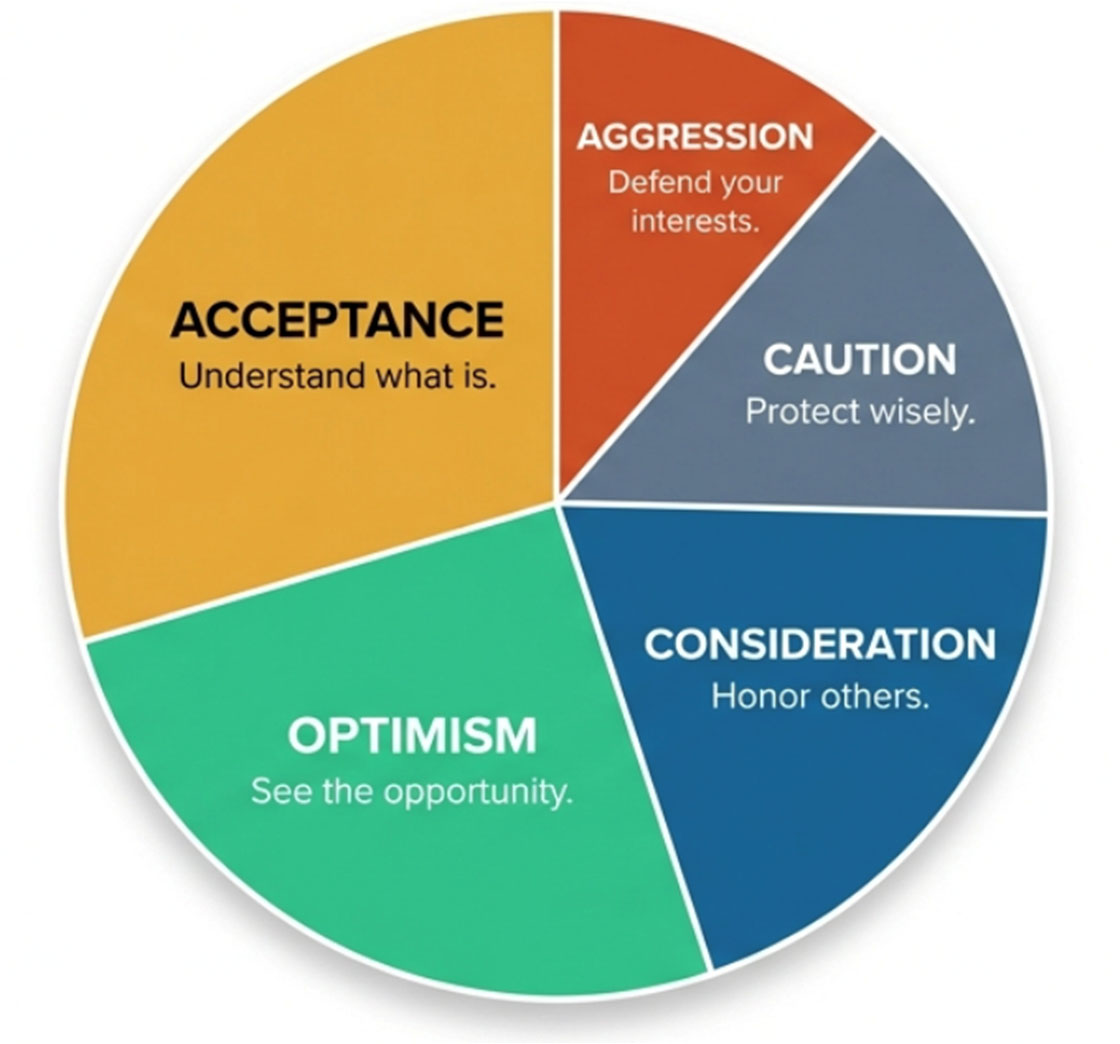
The circle is yours to calibrate. Just make sure all five pieces are in it
Acceptance: Understand What Is
This is the largest slice, and it should be. Everything else depends on it.
Acceptance is not surrender — it is the clarity to see reality as it is, so meaningful action can begin.
Life deals cards you didn't ask for. Markets turn and partners disappoint. Deals collapse for reasons that have nothing to do with how hard you worked. Other people behave in ways you wouldn't, sometimes from ignorance, sometimes from self-interest, sometimes from malice. Acceptance is the discipline of acknowledging what is without wasting finite energy arguing with reality.
This isn't passivity. The stoics resolved this two thousand years ago. You cannot control what happens, only how you respond. Acceptance clears the runway. The person who refuses a setback is still standing in the rubble shaking a fist. The person who accepts it has already started rebuilding. In business, acceptance shows up as the willingness to study bad numbers honestly and to recognize when a strategy has failed without ego. The builders I work with who struggle most are rarely the ones who lack talent. They're the ones who can't accept what the market is telling them.
Acceptance is the foundation. Without it, optimism morphs into delusion, caution into paranoia, aggression into bitterness.
Optimism: See the Opportunity
If acceptance is the foundation, optimism is the engine. It’s what moves you forward.
Optimism is not ignoring obstacles — it is believing there is still a path forward.
Optimism finds opportunity where others see only obstacle. It's the voice that says there is a way through, not because the evidence is conclusive but because the alternative is paralysis. Every business that was ever started, every home that was ever built, every risk that ever paid off began with someone choosing to believe the effort was worth making.
Untempered, optimism is dangerous. Without acceptance it becomes denial. Without caution it becomes recklessness. The right kind of optimism is informed. It examines the world clearly, weighs risk against reward, and acts anyway.
The great leaders I've known are almost universally optimistic, but theirs isn't the bumper-sticker variety. It's earned, the optimism of someone who has been knocked down, accepted the blow and gotten up enough times to know, with evidence, that getting up works.
This is the second-largest slice because forward motion is the essence of a productive life. Without optimism, acceptance hardens into resignation. The two need each other.
Consideration: Honor Others
How you treat other people is not a soft skill. It is a strategic orientation that determines the quality of every relationship you build, professional, personal and civic.
Trust compounds over time — and consideration is often where it begins.
Consideration means operating with the awareness that your decisions land on other people. Your employees have families. Your buyers are making the largest financial decision of their lives. The leader who carries consideration doesn't just know these things intellectually. They feel them, and that feeling shapes how they act.
Consideration earns trust, and trust compounds. The builder who treats trades fairly in a down market gets priority scheduling in the boom. The negotiator who leaves something on the table gets invited back to the next deal.
This is the middle slice, not the largest, because the world won't always reciprocate. But consideration is what separates leaders from bosses, partners from counterparties, and lives well-lived from lives merely successful.
Caution: Protect Wisely
Here the framework shows its honesty. Caution exists partly because not everyone else carries consideration, and partly to balance your own optimism before it carries you somewhere you can't afford to go.
Caution is the voice that says check the contract one more time, and don't assume goodwill when the stakes are high. It's the discipline of slowing down at precisely the moments excitement wants to accelerate. Every experienced operator has a story about the deal they didn't do, the one that looked perfect, and how walking away saved them.
Caution is not fear — it is the discipline that protects momentum from becoming recklessness.
Caution isn't fear. Fear is reactive and indiscriminate; it shuts everything down. Caution is selective and purposeful. It protects what matters most so optimism can operate freely everywhere else. Think of it as the braking system that lets you drive fast. Without brakes, you don't drive fast. You drive terrified, or you crash.
This is a smaller slice because a life dominated by caution is a life half-lived. But it's never absent from a well-constructed attitude. The people who skip it tend to learn its value in the most expensive way possible.
Aggression: Defend Your Interests
This is the smallest slice, and it should be. But its presence is non-negotiable.
Strength becomes destructive only when it loses balance.
Not everyone operates with consideration. Some will exploit your acceptance, take advantage of your optimism, and mistake your caution for weakness. There are moments when the only appropriate response is to stand up, push back, and make it unmistakably clear that you will protect your interests.
Aggression here isn't hostility. It isn't losing your temper or bulldozing people for sport. It's the willingness to be direct, firm, and unyielding when the situation demands. To say no without apology, and to fight for what's yours when someone is trying to take it.
Deployed least often, but when it's needed nothing substitutes for it. Acceptance won't help when someone is acting in bad faith. Optimism won't help when a predatory competitor targets your market. Consideration won't help when the other party has none. In those moments, the person with a complete attitude reaches for this slice and uses it without hesitation.
The key is that aggression lives inside the circle. It's informed by acceptance, so you see the situation clearly, and guided by caution, so you pick your battles. It returns to its proper proportion once the threat has passed. Aggression without the other four is belligerence. Inside the framework, it's strength.
The Living Circle
The proportions I've described represent a baseline, a default setting for an ordinary week. Life isn't always ordinary.
A tough negotiation may call for more aggression and caution, with optimism held in reserve. A personal loss may demand acceptance and optimism in equal measure, with aggression set aside entirely. A new venture may want optimism and aggression pushed forward, with caution deliberately, and temporarily, reduced.
Wisdom is not rigid consistency — it is knowing which perspective the moment requires.
The wise person doesn't lock into one mode. They read the situation and rebalance. The circle isn't a static diagram. It's a living instrument whose proportions shift with context and with the specific challenge in front of you on a given Tuesday afternoon.
This is what distinguishes a real attitude from the cardboard cutout version peddled in self-help books. A real attitude has texture. It has range. It acknowledges that the world is complicated enough to require multiple orientations, and that the person who carries only one, no matter how virtuous, is only partially equipped for it.
The One-Slice Trap
The title is deliberate. Having an attitude, a real one, a balanced one, is work. It requires holding five perspectives simultaneously and knowing which to lean into at any given moment. Most people don't do this. Most people find one slice that feels comfortable and give it disproportionate weight, crowding out the others until their attitude is dominated by a single orientation.
The perpetually aggrieved person has inflated aggression and eliminated acceptance. The naïve idealist has inflated optimism and eliminated caution. The cynic has inflated caution and eliminated optimism. Each is incomplete. Each will eventually be broken by the aspect of life they refused to account for. The alternative is to do the harder thing. Carry all five. Build an attitude that can absorb a blow, see a path forward, treat people well along the way, protect itself when necessary and know when to slow down. It doesn't guarantee an easy life. It guarantees a capable one.
That's what it means to get an attitude.
Written by Al Trellis in collaboration with Atlas by Real Torch. To put Atlas to work for your team, please contact Michael Burdette at michael@realtorch.ai